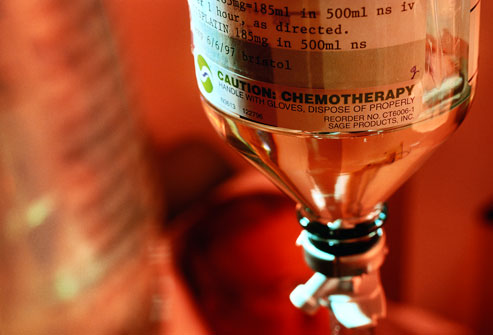
Shock study: Chemotherapy can backfire, make cancer worse by triggering tumor growth

Long considered the most effective cancer-fighting treatment, chemotherapy may actually make cancer worse, according to a shocking new study.
The extremely aggressive therapy, which kills both cancerous and healthy cells indiscriminately, can cause healthy cells to secrete a protein that sustains tumor growth and resistance to further treatment.
Researchers in the United States made the “completely unexpected” finding while seeking to explain why cancer cells are so resilient inside the human body when they are easy to kill in the lab.
They tested the effects of a type of chemotherapy on tissue collected from men with prostate cancer, and found “evidence of DNA damage” in healthy cells after treatment, the scientists wrote in Nature Medicine.
Chemotherapy works by inhibiting reproduction of fast-dividing cells such as those found in tumors.
The scientists found that healthy cells damaged by chemotherapy secreted more of a protein called WNT16B which boosts cancer cell survival.
"The increase in WNT16B was completely unexpected," study co-author Peter Nelson of the Fred Hutchinson Cancer Research Center in Seattle told AFP.
The protein was taken up by tumor cells neighboring the damaged cells.
"WNT16B, when secreted, would interact with nearby tumor cells and cause them to grow, invade, and importantly, resist subsequent therapy," said Nelson.
In cancer treatment, tumors often respond well initially, followed by rapid re-growth and then resistance to further chemotherapy.
Rates of tumor cell reproduction have been shown to accelerate between treatments.
"Our results indicate that damage responses in benign cells… may directly contribute to enhanced tumor growth kinetics," wrote the team.
The researchers said they confirmed their findings with breast and ovarian cancer tumors.
CANCER TREATMENT OVERVIEW
The result paves the way for research into new, improved treatment, said Nelson.
"For example, an antibody to WNT16B, given with chemotherapy, may improve responses (kill more tumor cells)," he said in an email exchange.
"Alternatively, it may be possible to use smaller, less toxic doses of therapy."Read more: http://www.nydailynews.com/life-style/health/shock-study-chemotherapy-backfire-cancer-worse-triggering-tumor-growth-article-1.1129897#ixzz2J8SFuP2D
Scientists found that healthy cells damaged by chemotherapy secreted more of a protein called WNT16B, which boosts cancer cell survival. ‘Th...
Baking Soda Cancer Cure

University of Arizona Cancer Center member Dr. Mark Pagel will receive a $2 million grant from the National Institutes of Health to study t...
Gatorade to remove flame retardant chemical from its drinks
Ah yes, you can hear Gatorade consumers concerns: “Yum - this fire retardant sure is tasty. Wonder if I can get some pure BVO if they take it out?” Not to worry, Gatorade gulpers, it will be several months before a new “flavor and color emulsifier” will be replacing the BVO fire retardant: sucrose acetate isobutyrate (SAIB).
Molly Carter asserted there’s no rush or specific date set for getting the reformulated drinks out. The reformulated Gatorade flavors “will start rolling out in the next few months,” Molly said.”We’re not recalling Gatorade. We don’t think our products are unsafe. We don’t think there are health or safety risks,” she claimed.
BVO has been banned as a food and beverage additive in Europe and Japan. But it has been used for decades in U.S. beverages such as Gatorade, Mountain Dew, Squirt, Fanta Orange, Sunkist Pineapple, Powerade Strawberry Lemonade or Fresca Original Citrus.
An observer from a gaming bar in the Atlanta, GA suburb of Marietta reports seeing video gamers stack up and drink a half-dozen or more Mountain Dews and gulp them down for their sugar and caffeine, keeping them stimulated and alert while gaming. They’re also unwittingly getting a strong dose of BVO flame retardant.
Binging on these BVO beverages has resulted in medical treatments for skin lesions, memory loss, or nervous disorders. According to Scientific American magazine, studies have indicated that BVO can accumulate in body tissues.
Mice exposed to bromine compound fire retardants exhibited long-term negative health and fertility events in some studies. But maybe it’s okay for humans. After all, BVO solutions are vegetable based. Unfortunately, the vegetables are soy and corn, which are usually GMO planted or GMO contaminated.
As early as 1977, the FDA approved BVO as a food or beverage additive at 15 parts per million. They based this figure on data from “industry studies.” Wonder which industry that might have been? But since then, BVO has been completely banned from foods and beverages in Japan and Europe. Maybe they know something about those long-term effects from BVO tissue accumulation.
So what’s the point of using BVOs in the first place? The heavy bromine atoms keeps synthetic artificial (tautology intentional) flavors from floating to the top of the beverage. Yum, toxic flavorings remaining constant throughout the beverage.
Source:
Brominated vegetable oil, a synthetic chemical that has been patented in Europe as a flame retardant, will no longer double as an ingredient...
Scientist that discovered GMO health hazards immediately fired, team dismantled

But rather than be praised for their honest assessment into this genetically-tampered potato, Pusztai and his colleagues were chastised by industry-backed government authorities, including British Prime Minister Tony Blair, whose office was discovered to have secretly contacted RRI just hours after Pusztai and his team announced the results of their study on television. For speaking the truth, Pusztai was immediately fired from his position, and his team dismissed from their positions at the school.
This elderly man is one of the most divisive figures in biology. Many blame him for tilting the balance in the PR battle over GM food towards public rejection. His research on GM potatoes - which came explosively into the public spotlight in a World in Action programme in August 1998 - has been dismissed as poorly done, muddled and even fabricated. Yet to anti-GM campaigners he is a hero - the scientist who stood up to the establishment and, as a result, had his career squashed at the behest of shadowy forces in the GM industry and the government.
"I think it did a lot of damage because … the vast majority of people were somewhat neutral at the time," said Professor Chris Leaver, a plant scientist and strong supporter of GM at Oxford University. "I think the NGOs … decided that they would make a play using him. I think he got hijacked and then he got out of his depth."
The affair finished off Pusztai’s research career (although at the time he was already 69) and affected his health. His supporters were appalled by his treatment at the hands of the publicly funded Rowett Research Institute in Aberdeen, which he had served with distinction for most of his career. He was regarded as a world expert on plant lectins - defensive proteins that kill insects and other invaders - with over 300 scientific papers, including two in the prestigious journal Nature.
"I would have characterised [his treatment] as disgraceful. I don’t see how any reputable scientist … could be treated in this way," said Dr Stanley Ewen, a pathologist who was then at the University of Aberdeen and who worked with Pusztai.
Having said of GM food in 1998: “If I had the choice I would certainly not eat it”, and that “I find it’s very unfair to use our fellow citizens as guinea pigs”, it’s easy to imagine Pusztai was ideologically opposed to GM. But this is far from the truth, he tells me. “I’m strictly science-based … It is not an ideology for me.” Still, he confesses that his opposition to the technology has hardened over the years, and he still won’t eat it. “Even now, I am not a campaigner. I have never belonged to any organisation campaigning for or against it.”
He felt he had a duty to speak out, “just to inject some caution into this business”, he says. “Make no mistake, this is an irreversible technology. It is no good 50 years later to say: ‘We should have known.’”
Concerns aired
Pusztai clearly wanted his concerns to be aired publicly, but he does not come across as a man who relished or courted publicity. He was very happy, for example, that the institute’s director, Philip James, shielded him from interview requests. “I was quite happy with this … I am an academic scientist. I’ve never been exposed to this,” he says, “I’m really not a very media person.”
Pusztai says James, on the other hand, was anxious to exploit the media attention. “The director kept running around like a blue-arsed fly. This was a tremendous public relations business for him.”
James even put in a complimentary phone call to Pusztai that August evening. “I telephoned Pusztai immediately after the broadcast to congratulate him on the modest way in which he had presented the evidence on the programme,” says James, although he denies relishing the publicity. He says he had grave doubts about the interview going ahead in the first place.
By this stage, Pusztai was feeling extremely uncomfortable about what he was hearing on news bulletins about his own research. “I heard things that really disturbed me,” he says. “My head was buzzing … the whole thing was getting totally out of hand.”
The results that Pusztai had hinted at in his interview were a comparison of rats fed ordinary potatoes and potatoes that had been genetically modified with a lectin from snowdrops. The rats on the GM diet grew less well and had immune problems even though the lectin itself caused no adverse effects at high concentrations. His conclusion was that the GM process had somehow made the potatoes less nutritious. The GM potatoes were not a commercial variety and were never intended for human consumption, but the lectin modification - which made them poisonous to insects - was an experimental model for other GM varieties.
But newspaper stories generated confusion over the nature of the genetic modification. These articles refer to potatoes modified with a lectin gene from jackbean that is poisonous to mammals. But no one can agree on where this came from. The misinformation was formalised in a press release issued by the Rowett. James says Pusztai approved it. Pusztai says he was not aware of it until it was published. Either way, the jackbean experiments that never were have proved extremely damaging to Pusztai. Even now, GM scientists dismiss Pusztai’s work on the grounds of a supposed schoolboy error: of course the rats suffered, they say, they were being fed potatoes that were genetically modified to produce a poison.
The day after the World in Action programme, Pusztai’s boss changed his mood from congratulation to condemnation. “My change in attitude was dramatic because I discovered that Pusztai … had never conducted the studies which he had claimed,” says James, an accusation that Pusztai strongly denies. He says he never claimed to have done the jackbean experiments. “He just simply wanted to put a real cap on it,” says Pusztai. “The simplest way to do it was to suspend all research activities into this business.” Pusztai’s supporters claim that James came under pressure from Downing Street to put a lid on the affair.
Suspended and silenced
James suspended Pusztai and used misconduct procedures to seize his data. Pusztai’s rolling annual contract was not renewed and he was banned from speaking publicly. Pusztai says he wanted to publish his results but was concerned that James would veto any approach to an academic journal.
In 1998, if James had hoped that gagging Pusztai would make the affair go away he was wrong. Continued media speculation was doing considerable damage to public confidence in GM food and this prompted the Royal Society - the UK’s premier scientific academy - to enter the fray.
Although none of Pusztai’s results had yet been published, it set about reviewing the information that did exist - an internal report written by Pusztai, an audit of the data produced by the Rowett, and an independent statistical analysis carried out by Biomathematics and Statistics Scotland. The data was sent to six anonymous reviewers. The subsequent report savaged Pusztai’s results, but he remains defiant.
The Royal Society putdown was predictable. The reviewers had placed a hotchpotch of lab reports and statistical analyses that were never intended for publication under intense scrutiny. “There was practically nothing in it but numbers,” says Pusztai. He and Ewen point out that peer reviewers had praised the methodological details of the experiment when their application for a £1.6m research grant from the Scottish Office was given the go-ahead.
Some of the disputed data did eventually see the light of day in October 1999, when Ewen and Puztai published a paper in the prestigious medical journal the Lancet. Because of its controversial nature, the data paper was seen by six reviewers - three times the usual number. Five gave it the green light. The paper - which used data held by Ewen and so was not subject to veto by James - showed that rats fed on potatoes genetically modified with the snowdrop lectin had unusual changes to their gut tissue compared with rats fed on normal potatoes. It has been criticised on the grounds that the unmodified potatoes were not a fair control diet.
I put it to Pusztai that he is demanding a level of testing for GM food that is not applied to conventional plant breeding. Radiation and mutation-causing chemicals, for example, are standard techniques used to create new varieties, and both can create unexpected genetic changes. He bats this away. “Two negatives don’t make a positive,” he responds. “It doesn’t mean that I agree with those techniques.”
The difference with GM, he says, is that there is a political agenda at work. “Ninety-five per cent of GM is coming from America, so naturally it is in their interests to push it,” he says, “I have no ideological grounds against Monsanto [the biotechnology company]. For me it’s a scientific argument. They have not done a proper job [of testing], and they are just using their political and economic muscle to foist it on us.”
Does he regret speaking publicly about his research prior to publication - generally regarded as a cardinal sin by scientists? “No,” he says. “I was publicly funded and I thought the public had a right to know.” He also rejects the notion that he would have achieved more by waiting until the science was in print. Since he went public, he estimates he has given between 150 and 200 lectures around the world. And in 2005 he was honoured with a whistleblower award from the Federation of German Scientists.
"Even our best scientific publications - I don’t think they are read by more than 50 people," he says. "This had impact … to my damage, but it had impact."
Though it barely received any media attention at the time, a renowned British biochemist who back in 1998 exposed the shocking truth about ...

Indian Farmers Trapped and Desperate

The number of farmer suicides is the largest in human history is estimated to have reached 300,000+ and rising as we speak. India has the la...
Top seven natural cures for cancer that got buried by the FDA, AMA, CDC

Just in case you "doubters" and skeptics want some concrete proof, some evidence to take with you on your journey NOT to get cancer, here are some historical, proven facts to help you understand WHY you need to go 100% organic and research and use natural remedies, to build your immunity to disease with superfoods, herbs, tinctures and organic supplements. (http://www.naturalnews.com)
Let's begin this journey of truth and the not-so-healthy history of medicine in this bold country we call the "Land of the Free." Let's begin with the TOP SEVEN CURES for cancer that mainstream media will never admit to, because their advertising money comes from Big Pharma, the GMO Agriculture giants (Monsanto/Dupont/Bayer/Dow Chemical/etc.) and the lobbyists and politicians who make their money off of stocks in cancer therapies that don't work:
1. The AMA once paid a cancer virus researcher $250K to retire in Mexico and stop working on natural cures:
(http://www.naturalnews.com)
2. Burzynski documentary reveals true agenda of FDA and cancer industry to destroy cancer cures that really work:
(http://www.naturalnews.com)
3. 'Dying to Have Known' documentary features Gerson Therapy natural cancer cure:
(http://www.naturalnews.com)
4. Harry Hoxsey: Guilty of Curing Cancer with Herbs:
(http://www.naturalnews.com)
5. Magic mushrooms could treat depression, but clinical trials unnecessarily delayed by drug laws:
(http://www.naturalnews.com)
6. Marijuana - A cure for cancer?
(http://www.naturalnews.com)
7. Beat cancer with 35% hydrogen peroxide!
(http://www.naturalnews.com)
Pay it forward 100 years
Nearly 100 years ago, the AMA began removing nutritional education from medical schools in America. Medical doctors would no longer understand anything about using food as medicine (or be allowed to suggest it), and all mid-wives, Native American herbalists and natural healers would be referred to in medical journals as "quacks." The Western Medicine philosophy would soon come to be that no food in the world could ever heal a human being or cure any disease or disorder; in fact, only pharmaceuticals and vaccines would ever be able to make that claim (legally) and get away with it, whether in peer reviews, medical and science journals (JAMA), scientific "studies" or labeled as such on products. (http://www.naturalnews.com)Currently, it is illegal for any food, herb, tincture or superfood product to say that it cures anything, yet medications advertised on TV since 1997 can say they treat all kinds of diseases and disorders, even though the side effects are horrendous, some of the time including internal bleeding and suicide. (http://www.naturalnews.com)
Read more:
How do you keep the spread of cancer "growing"? Bury the cure. How do you keep 1.5 million Americans "infested" yearl...
Popular Posts
-
His father was called the 'worst kind of war criminal' and told he would burn in hell by the judge who sentenced him to life in pr...
-
marketing READ AND SHARE PLEASE Cannabis sativa hemp, the miracle plant, contains the cure for cancer and other ailments The US Govt ...
-
Islam is at it again the so called religion of peace, this time with the burning alive of over 50 Christians. Christianity has always been ...
-
Americans are slowly waking up to the sad fact that much of the food sold in the US is far inferior to the same foods sold in other nations....
-
There over 800 prison camps in the United States, all fully operational and ready to receive prisoners. They are all staffed and even surrou...
-
By Rick Simpson My name is Rick Simpson. I have been providing people with Hemp Oil medicines, at no cost, for about three years. The resu...
-
Christians are not made in a laboratory, but in a community called the church, Pope Francis said. At his weekly general audience Wednes...
-
Hamburger chef Jamie Oliver has won his long-fought battle against one of the largest fast food chains in the world – McDonalds. After Oliv...
-
On Sunday March 21, 2010 the Senate Healthcare bill HR3200 was passed and signed into law the following Tuesday. Like I said before, there a...
-
Dr. Kimberly Quinlan Lindsey , a top official with the Centers for Disease Control and Prevention (CDC) has been arrested and charged with ...